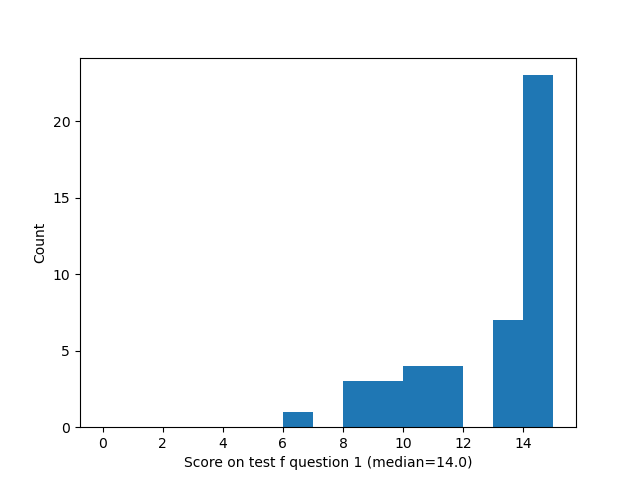
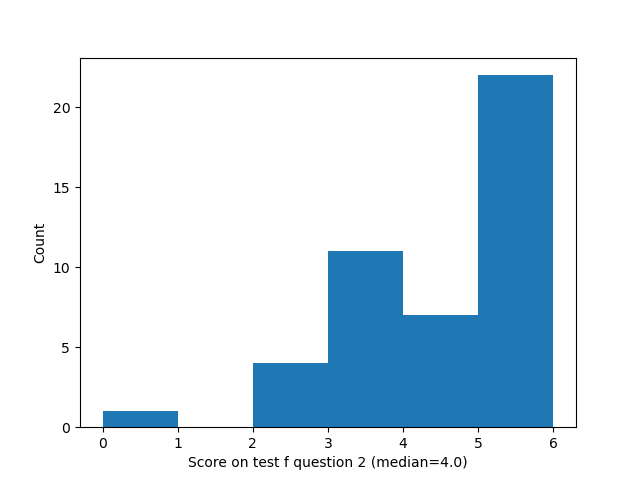
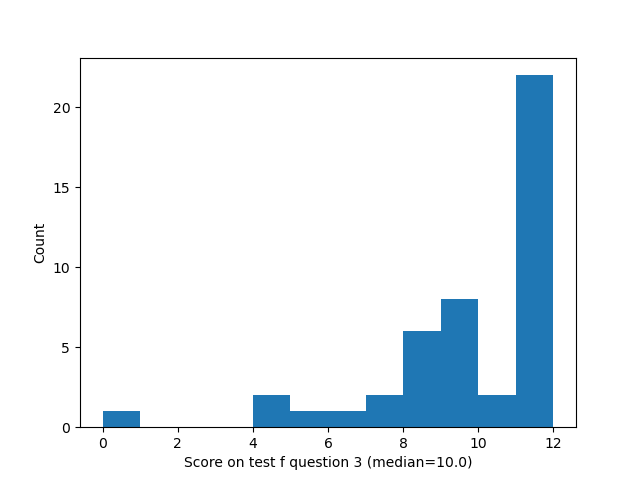
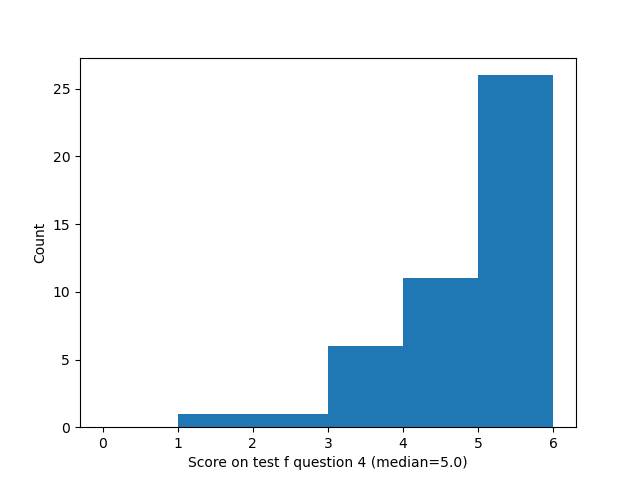
for MATH 3300 and 5300 Calculus III, Spring 2025-26.
Find the orthogonal projection of \(\vec{u}=\langle -1,3 \rangle\) onto \(\vec{v}=\langle 5,2 \rangle\) (which is denoted \(\mathrm{proj}_{\vec{v}}\vec{u}\)).
[similar to 11.3 #24] \[\mathrm{proj}_{\vec{v}}\vec{u} = \frac{\vec{u}\cdot\vec{v}}{\vec{v}\cdot\vec{v}}\vec{v} =\frac{1}{29}\langle 5,2 \rangle = \langle \frac{5}{29},\frac{2}{29} \rangle .\]
Write the vector and parametric equations for the line that passes through the point \(P=( 3,-5 ,5)\) and is parallel to \(\vec{d}=\langle 3, 1, 2 \rangle\).
[similar to 11.5 # 5] The vector equation is \[\vec{\ell}(t)=\overrightarrow{0P}+t \vec{d}=\langle 3,-5 ,5\rangle +t\langle 3,1, 2 \rangle ,\] so the parametric equations are \[\begin{aligned} x&= 3+3t\\ y&= -5+t\text{ and}\\ z&= 5+2t \,. \end{aligned}\]
Find the equation in general form for the plane that passes through the points \(P=(1,-1,1)\), \(Q=(2,2,1)\), and \(R=(2,3,2)\).
[similar to 11.6 # 9] Select two vectors in the plane, such as \[\begin{aligned} \vec{u}&= \overrightarrow{PQ} = \langle 2,2,1 \rangle - \langle 1,-1,1\rangle = \langle 1,3,0\rangle\\ \vec{v}&= \overrightarrow{RQ} = \langle 2,2,1 \rangle - \langle 2,3,2\rangle = \langle 0,-1,-1\rangle . \end{aligned}\] Compute a normal vector \[\vec{n} = \vec{u} \times \vec{v} =\left|\begin{matrix} \vec{i} & \vec{j} & \vec{k}\\ 1 & 3 & 0\\ 0 & -1 & -1 \end{matrix} \right| = (-3\vec{i}+ 0\vec{j}-1\vec{k})-(0\vec{k}-1\vec{j}+0\vec{i}) =-3\vec{i}+ 1\vec{j}-1\vec{k} = \langle -3,1,-1\rangle.\] Using \(P\) as the base point, an equation in standard form is \[0 = \vec{n} \cdot (\vec{x}-\overrightarrow{0P}) = -3(x-1)+1(y+1)-1(z-1)\] so the equation in general form is \[-3x+y-z=-5 .\]
Find an equation for the tangent line to the graph of \(\vec{r}(t)=\langle \sin(t), 3\cos(5t) \rangle\) at \(t=\pi/4\).
[similar to 12.2 #24] We compute \(\vec{r}'(t)=\langle \cos(t), -15\sin(5t) \rangle\), so \[\begin{aligned} \ell(t) = \vec{r}(\pi/4) + t \vec{r}'(\pi/4) &= \langle \sin(\pi/4), 3\cos(5\pi/4) \rangle +t \langle \cos(\pi/4), -15\sin(5\pi/4) \rangle\\ &= \langle 1/\sqrt{2}, -3/\sqrt{2} \rangle + t \langle 1/\sqrt{2}, 15/\sqrt{2} \rangle \end{aligned}\]
Find an equation for the normal line to the surface \(2x^2+y^2+3z^3=27\) at the point \(P=(-1,1,2)\).
[similar to 13.7 #21] Consider the surface as the level surface of a function \(f(x,y,z)\) and compute the gradient \[\nabla f(x,y,z) = \langle 4x, 2y, 9z^2 \rangle.\] The gradient is orthogonal to the surface, so an equation for the normal line is \[l(t) = \langle -1,1,2 \rangle + t \nabla f(-1,1,2) =\langle -1,1,2 \rangle + t \langle -4,2,36 \rangle.\]
Find the critical points of the function \(\displaystyle f(x,y)=\frac{1}{3}x^3-x +\frac{1}{3}y^3-4y\). Use the Second Derivative Test to determine if each critical point corresponds to a relative maximum, relative minimum, or saddle point.
[similar to 13.8 #12] Compute the gradient \[\nabla f(x,y) = \langle x^2-1, y^2-4\rangle\] and set equal to \(\langle 0,0\rangle\). The first component gives \(x=\pm 1\) and the second component gives \(y=\pm 2\), so the critical points are \((-1,-2)\), \((-1,2)\), \((1,-2)\), and \((1,2)\). \[f_{xx}(x,y)=2x,\quad f_{yy}(x,y)=2y,\quad \text{and } f_{xy}(x,y)=0,\] so \(D(x,y)= 2x2y-0=4xy\). Plugging in each point gives \[\begin{aligned} D(-1,-2) &= 8 > 0 \quad\text{and}\quad f_{xx}(-1,-2)=-2 <0 \quad\Rightarrow\quad\text{maximum}\\ D(-1,2) &= -8 <0 \quad\Rightarrow\quad\text{saddle} \\ D(1,-2) &= -8 <0 \quad\Rightarrow\quad\text{saddle}\\ D(1,2) &= 8 > 0 \quad\text{and}\quad f_{xx}(1,2)=2 >0 \quad\Rightarrow\quad\text{minimum} \end{aligned}\]
Switch the order of integration in the iterated integral \(\displaystyle \int_{0}^{1}\int_{5-5x}^{5-5x^2} dydx\) to give another iterated integral that computes the same area. (You do not need to compute the integral.)
[14.1 #18] As \(x\) ranges from \(0\) to \(1\), \(y\) goes from 5 to 4. Solving \(y=5-5x\) and \(y=5-5x^2\) for \(x\) yield \(x=1-y/5\) and \(x=\sqrt{1-y/5}\), so we have \[\int_{0}^{5}\int_{1-y/5}^{\sqrt{1-y/5}} dxdy\]
Rewrite the integral \(\displaystyle \int_{0}^{2} \int_{x}^{\sqrt{8-x^2}} (x+y)dy\,dx\) in polar coordinates. (You do not need to compute the integral.)
[similar to 14.3 #13] The region is a sector of a disc, with \(\pi/4\le \theta \le \pi/2\) and \(0\le r \le \sqrt{8}\). We thus get \[\begin{aligned} & \int_{\pi/4}^{\pi/2} \int_{0}^{\sqrt{8}} (r\cos(\theta)+r\sin(\theta))rdr\,d\theta \end{aligned}\]
Set up and evaluate the double integral to find the
volume
between \(f_1(x,y)=\sin(x)\cos(y)\) and
\(f_2(x,y)=\cos(x)\sin(y)+2\)
over the triangle with corners \((0,0)\), \((0,\pi)\), and \((\pi,\pi)\).
[similar to 14.6 #7] \[\begin{aligned} \int_{0}^{\pi} \int_{x}^{\pi} \left(f_2(x,y)-f_1(x,y)\right)dydx &= \int_{0}^{\pi} \int_{x}^{\pi} \left(\cos(x)\sin(y)+2-\sin(x)\cos(y)\right)dydx\\ &= \int_{0}^{\pi} \left. -\cos(x)\cos(y)+2y-\sin(x)\sin(y) \right|_{x}^{\pi} dx\\ &= \int_{0}^{\pi} \left( -\cos(x)\cos(\pi)+2\pi-\sin(x)\sin(\pi) \right) -\left( -\cos(x)\cos(x)+2x-\sin(x)\sin(x) \right) dx \\ &= \int_{0}^{\pi} 2\pi+1-2x +\cos(x) dx = \left. (\pi+1)x - x^2 + \sin(x)\right|_{0}^{\pi}\\ &= (2\pi+1)\pi - \pi^2 +0 - 0 = \pi^2+\pi\,. \end{aligned}\]
Consider the vector field \(\vec{F}=\langle 2xyz,x^2z,x^2y\rangle\).
[similar to 15.3 #19]
Find a potential function \(f\) for \(\vec{F}\).
We know \(\vec{F}=\langle f_x,f_y,f_z\rangle\), so antidifferentiating each partial derivative yields \(f(x,y,z)=x^2yz+C_1(y,z)=x^2yz+C_2(x,z)+x^2yz=C_3(x,y)\) and we can take \(C_1(y,z)=C_2(x,z)=C_3(x,y)=0\), so \(f(x,y,z)=x^2yz\) is a potential function.
Use the Fundamental Theorem of Line Integrals to evaluate \(\int_C \vec F\cdot d\vec r\), where \(C\) is a curve going from \((1,2,3)\) to \((-1,5,-2)\).
By the theorem, \[\int_C \vec F\cdot d\vec r = f(-1,5,-2)-f(1,2,3) = (-1)^2(5)(-2)-1^2(2)(3)=-10-6=-16.\]
Let \(\mathcal{S}\) be the plane \(z=x+3y\) over the triangle with vertices at \((0,0)\), \((1,0)\), and \((0,1)\).
[similar to 15.5 #18]
Find a parameterization \(\vec{r}(u,v)\) for \(\mathcal{S}\).
We can let \(\vec r(u,v) = \langle u, v(1-u), u+3v(1-u)\rangle\) with \(u\in [0,1]\) and \(v\in [0,1]\).
Set up the integral to compute the surface area of \(\mathcal{S}\). (You do not need to evaluate the integral.)
We have \[\begin{aligned} \vec{r}_u &= \langle 1, -v, 1-3v \rangle\\ \vec{r}_v &= \langle 0, 1-u, 3(1-u)\rangle \end{aligned}\] so \[\begin{aligned} \vec{r}_u \times \vec{r}_v =& \begin{vmatrix} \mathbf{i} & \mathbf{j} & \mathbf{k}\\ 1 & -v & 1-3v \\ 0 & 1-u & 3(1-u) \end{vmatrix} = \langle -3v(1-u) -(1-3v)(1-u), -3(1-u), 1-u\rangle\\ & = \langle -(1-u), -3(1-u), 1-u\rangle\\ \|\vec{r}_u \times \vec{r}_v\| =& \sqrt{(1-u)^2+9(1-u)^2+(1-u)^2}=\sqrt{11}|1-u| \end{aligned}\] Thus the surface area integral is \[S = \iint_\mathcal{S}\, dS = \iint_R \|{\vec r_u\times \vec r_v}\| dA = \int_{0}^{1} \int_{0}^{1} \sqrt{11}|1-u| du dv\]
Note: The solution above follows the method in section 15.5, from which this problem was taken, and where the domain of \((u,v)\) is implicitly assumed to be a rectangle. Many students used the simpler parameterization \(\vec r(u,v) = \langle u, v, u+3v\rangle\) with \(u\in [0,1]\) and \(v\in [0,1-u]\), which then leads to the surface area integral \(\int_{0}^{1} \int_{0}^{1-u} \sqrt{11} dv du\).
Let \(\vec{F}=\langle -y,
x\rangle\), \(C\) be the unit
circle, \(\vec{r}(t)\) be a
counterclockwise parameterization of \(C\),
and \(R\) be the unit disc.
Compute \(\oint_C\vec F\cdot d\vec r\)
Parameterize the circle by \(\vec{r}(t)=\langle\cos(t),\sin(t)\rangle\) for \(t\in [0,2\pi]\) so \(\vec{r}'(t)=\langle-\sin(t),\cos(t)\rangle\) and \(\vec{F}=\langle -\sin(t), \cos(t)\rangle\). We then have \[\begin{aligned} \oint_C\vec F\cdot d\vec r =& \int_{0}^{2\pi}\langle -\sin(t), \cos(t)\rangle \cdot \langle-\sin(t),\cos(t)\rangle dt = \int_{0}^{2\pi}\sin^2(t)+ \cos^2(t) dt =2\pi \end{aligned}\]
Compute \(\oint_C\vec F\cdot \vec n\, ds\)
We can convert \(\vec{n}ds= \langle\cos(t),\sin(t)\rangle dt\), so \[\begin{aligned} \oint_C\vec F\cdot \vec n\, ds =& \int_{0}^{2\pi}\langle -\sin(t), \cos(t)\rangle \cdot \langle\cos(t),\sin(t)\rangle dt\\ &=\int_{0}^{2\pi} -\sin(t)\cos(t) + \sin(t)\cos(t)dt =\int_{0}^{2\pi} 0 dt = 0 \end{aligned}\]
Compute \(\iint_R \mathrm{curl} \vec F\, dA\)
\(\mathrm{curl} \vec F = 1-(-1)=2\). Since we know that the area of the unit disc is \(\pi\), we have \[\iint_R \mathrm{curl} \vec F\, dA = 2\iint_R dA = 2\pi\]
Compute \(\iint_R \mathrm{div} \vec F\, dA\)
\(\mathrm{div}\vec F=0+0=0\), so \(\iint_R \mathrm{div} \vec F\, dA=0\).
Explain how these integrals relate to Green’s theorem, Stokes’ theorem, and/or the Divergence theorem.
By Green’s theorem, \(\oint_C\vec F\cdot d\vec r=\iint_R \mathrm{curl} \vec F\, dA\) and by the (2-dimensional) Divergence theorem, \(\oint_C\vec F\cdot \vec n\, ds=\iint_R \mathrm{div} \vec F\, dA\).
Let \(D\) be the domain enclosed
by \(z=xy(3-x)(3-y)\) and \(z=0\),
let \(\mathcal{S}\) be the surface of
this domain, and
let \(\vec{F}=\langle 5x,
7y,11+z\rangle\).
Set up the integral \(\iint_\mathcal{S} \vec F\cdot\vec n\, dS\). (You do not need to evaluate the integral.)
[similar to 15.7 #7]
We can parameterize the top surface \(\mathcal{S}_\mathrm{top}\) by
\(\vec{r}(u,v) = \langle u, v,
uv(3-u)(3-v)\rangle\) for \(u\in
[0,3]\) and \(v\in [0,3]\), so
\[\begin{aligned}
\vec{r}_u &= \langle 1,0, (3-2u)v(3-v)\rangle\\
\vec{r}_v &= \langle 0,1,(3-2v)u(3-u)\rangle\\
\vec{r}_u \times \vec{r}_v &=
\begin{vmatrix}
\mathbf{i} & \mathbf{j} & \mathbf{k}\\
1 & 0& (3-2u)v(3-v)\\
0 & 1 & (3-2v)u(3-u)
\end{vmatrix}
= \langle -(3-2u)v(3-v) ,-(3-2v)u(3-u) ,1\rangle \\
\vec{F} & = \langle 5u, 7v,11+uv(3-u)(3-v)\rangle
\end{aligned}\] so \[\begin{aligned}
\iint_{\mathcal{S}_\mathrm{top}} \vec F\cdot\vec n\, dS
&= \int_{0}^{3} \int_{0}^{3}
\langle 5u, 7v,11+uv(3-u)(3-v)\rangle \cdot \langle
-(3-2u)v(3-v) ,-(3-2v)u(3-u) ,1\rangle
dudv \\
&= \int_{0}^{3} \int_{0}^{3}
-5u(3-2u)v(3-v) - 7v(3-2v)u(3-u) + 11+uv(3-u)(3-v)dudv
\end{aligned}\] We can parameterize the bottom surface \(\mathcal{S}_\mathrm{bottom}\) by \(\vec{r}(u,v) = \langle u, v, 0\rangle\) for
\(u\in [0,3]\) and \(v\in [0,3]\), so \[\begin{aligned}
\vec{r}_u &= \langle 1,0, 0\rangle\\
\vec{r}_v &= \langle 0,1,0\rangle\\
\vec{r}_u \times \vec{r}_v &=
\begin{vmatrix}
\mathbf{i} & \mathbf{j} & \mathbf{k}\\
1 & 0& 0\\
0 & 1 & 0
\end{vmatrix}
= \langle 0,0,1\rangle \\
\vec{F} & = \langle 5u, 7v,11\rangle.
\end{aligned}\] Since \(\vec{r}_u
\times \vec{r}_v\) has positive \(z\)-component but we want the outward
normal, we use \(-\vec{r}_u \times
\vec{r}_v\) and get \[\begin{aligned}
\iint_{\mathcal{S}_\mathrm{bottom}} \vec F\cdot\vec n\, dS
&= \int_{0}^{3} \int_{0}^{3}
\langle 5u, 7v,11\rangle \cdot \langle 0 ,0 ,-1\rangle
dudv
= \int_{0}^{3} \int_{0}^{3}-11dudv
\end{aligned}\] The integral over \(\mathcal{S}\) is the sum of these two.
Set up the integral \(\iiint_D \mathrm{div} \vec F\, dV\). (You do not need to evaluate the integral.)
\(\mathrm{div} \vec F = 5+7+1=13\), so we have \[\int_{0}^{3}\int_{0}^{3} \int_{0}^{xy(3-x)(3-y)} 13 dz dy dx\]
Explain how these integrals relate to Green’s theorem, Stokes’ theorem, and/or the Divergence theorem.
By the (3-dimensional) Divergence theorem, these integrals have the same value.
Last modified: Mon May 4 13:17:34 UTC 2026